2017 Ford Expedition Speaker Sizes and Audio System Guide
2017 Ford Expedition Speaker Sizes and Audio System Guide
Save this audio guide to your Ownery garage
This page outlines the factory speaker layout, common upgrade considerations, and the audio equipment differences for the 2017 Ford Expedition. Speaker and system details can vary by trim, body style, or audio package, so the exact setup should be checked against the vehicle’s build. Factory amplifier details should be verified by trim and audio package, and tweeters or a subwoofer may be included if equipped.
Data verified by Nick Marchenko, PhD
Speaker Size Chart – 2017 Ford Expedition
Use this table as the main reference. Fitment depends on trim, factory audio package, mounting depth, and adapter availability.
| Location | Type | Factory Size | Note |
|---|---|---|---|
| Front Door | Tweeter | 1.5 inch | if equipped |
| Front Door | Full-Range | 6 x 8 inch | |
| Rear Door | Full-Range | 6 x 8 inch | |
| Far-Rear Side Panels | Subwoofer | 8 inch | if equipped |
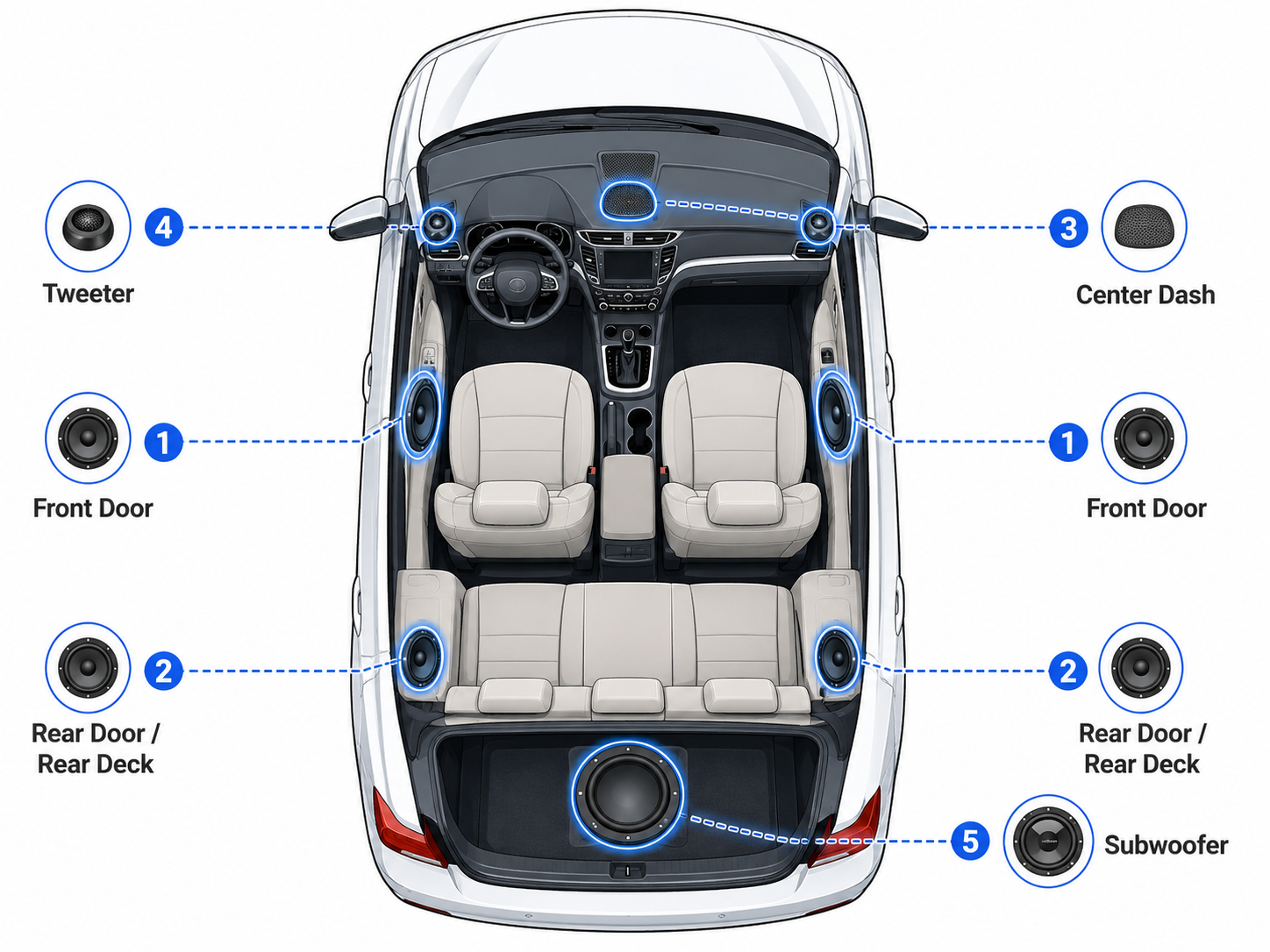
Generic speaker location diagram. The table above shows the specific factory sizes for this vehicle. Exact location details may vary by body style and trim.
Speaker Count by Trim – 2017 Ford Expedition
Speaker count and audio equipment vary by trim and factory audio package. This table lists known configurations from our database.
| Trim | Speakers | Amplifier | Radio | Navigation |
|---|---|---|---|---|
| King Ranch 4dr 4x2 | 12 | std | SiriusXM AM/FM/HD/Satellite, seek-scan | ✓ |
| King Ranch 4dr 4x4 | 12 | std | SiriusXM AM/FM/HD/Satellite, seek-scan | ✓ |
| Limited 4dr 4x2 | 12 | std | SiriusXM AM/FM/HD/Satellite, seek-scan | ✓ |
| Limited 4dr 4x4 | 12 | std | SiriusXM AM/FM/HD/Satellite, seek-scan | ✓ |
| Platinum 4dr 4x2 | 12 | std | SiriusXM AM/FM/HD/Satellite, seek-scan | ✓ |
| Platinum 4dr 4x4 | 12 | std | SiriusXM AM/FM/HD/Satellite, seek-scan | ✓ |
| XLT 4dr 4x2 | 6 | – | SiriusXM AM/FM/HD/Satellite, seek-scan | ✓ |
| XLT 4dr 4x4 | 6 | – | SiriusXM AM/FM/HD/Satellite, seek-scan | ✓ |
Data sourced from manufacturer specifications. Verify with the window sticker or dealer before ordering audio components.
Vehicle and Audio System Specifications
This block helps identify the vehicle and its audio system configuration for fitment decisions.
What Speakers Fit the 2017 Ford Expedition?
Aftermarket fitment should start with the factory speaker locations listed for this 2017 Ford Expedition, but diameter alone is not enough. Check mounting depth, bracket fit, connector type, and whether your vehicle has a premium or factory-amplified audio system. The front and rear doors use 6 x 8 inch full-range speakers, while front door tweeters and an 8 inch rear subwoofer may be present if equipped. Speaker count can vary by trim, so verify the exact audio package before buying.
Usually Safe Upgrades
- If your vehicle uses the front door 6 x 8 inch location, a quality 6 x 8 inch full-range speaker is the safest starting point.
- If your vehicle uses the rear door 6 x 8 inch location, a matching 6 x 8 inch full-range speaker should align with the factory opening.
- If your vehicle has the front door tweeter location if equipped, a 1.5 inch tweeter replacement or upgrade should be matched to that opening.
- If your vehicle has the far-rear side panel 8 inch subwoofer if equipped, choose an 8 inch subwoofer that matches the factory location and system requirements.
Check Before Buying
- Confirm whether your trim is the 6-speaker or 12-speaker setup, since equipment can vary by trim.
- Verify mounting depth and speaker basket clearance before ordering, especially for the front door and rear door locations.
- Check the factory connector style and whether an adapter or harness is needed for your chosen speaker.
- If your vehicle has a factory amplifier, confirm compatibility with the audio package before selecting replacement speakers.
- Make sure any tweeter or subwoofer upgrade is chosen only if that location is equipped on your vehicle.
Installation Notes
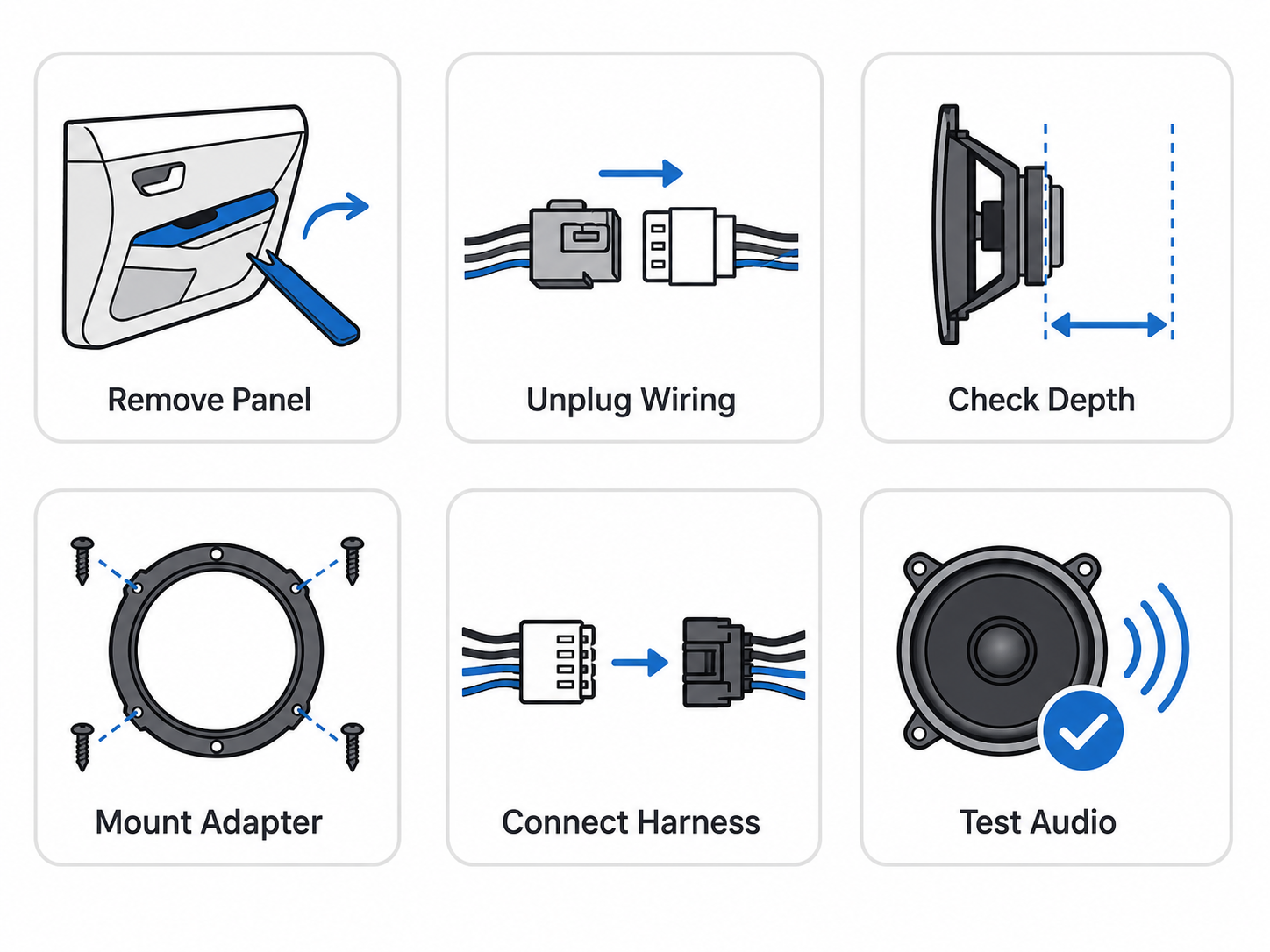
The 2017 Ford Expedition uses 6 x 8 inch full-range speakers in the front and rear doors, and some vehicles may also have 1.5 inch front door tweeters and an 8 inch rear side-panel subwoofer if equipped. Before starting, verify your trim and audio package so you know which speaker locations are present and whether a factory amplifier is involved. Panel removal is required for access, so work carefully to avoid breaking clips or damaging trim surfaces. Speaker depth should be checked before ordering replacements, especially in the front doors where clearance can be limited. Mounting adapters may be needed to secure aftermarket speakers properly, and harness adapters can help keep factory wiring intact. If your vehicle has the factory subwoofer, match the replacement to the enclosure and confirm polarity before reassembly. After installation, test each speaker location individually, including tweeters and subwoofer if equipped, to make sure balance, fade, and bass response are correct.
Moderate difficulty, since trim removal, wiring checks, and fitment verification are important for a clean installation.
Common Mistakes When Replacing Speakers
When shopping for audio upgrades on the 2017 Ford Expedition, the biggest problems usually come from assuming every trim shares the same speaker layout or skipping fitment checks before buying parts.
- Buying based only on the body-style label instead of checking actual speaker locations on the vehicle.
- Ignoring trim and audio package differences, since speaker count and amplifier setup can change from 6 to 12 speakers depending on the trim.
- Assuming the front door tweeters are always present, when they are listed as if equipped and should be verified before ordering replacement parts.
- Overlooking the optional rear subwoofer location, which may be present only on certain audio setups and should be confirmed on the vehicle.
- Choosing speakers without checking mounting depth and connector style, which can cause fitment problems even when the size looks correct on paper.
- Reassembling the doors and panels before testing the new speakers, amplifier, and radio functions to make sure everything works properly first.
Generation & Model Family
The 2017 Ford Expedition belongs to the Third generation (U324) - Facelift (2015–2017) family. Nearby model years often share similar speaker locations and audio layouts, but exact fitment can vary by trim and audio package – verify before ordering.
Recommended Upgrade Path
The 2017 Ford Expedition uses a speaker layout that can vary by trim and audio package, so the best upgrade plan depends on your current system. Some versions include factory tweeters and a rear subwoofer, while others are simpler. A smart upgrade path starts with the front stage, then adds bass or amplification based on your goals and equipment.
| Goal | Best Upgrade Path | Why |
|---|---|---|
| Better clarity | Upgrade the front door speakers first, and if equipped, replace the factory tweeters with higher-quality components that improve detail and imaging. If your system includes a factory amplifier, verify trim and audio package compatibility before choosing new speakers. | Clarity comes from the front stage, where most vocals and high-frequency detail are heard. Improving the front speakers and tweeters can make the system sound cleaner without changing the rest of the vehicle audio setup. |
| More bass | If equipped with the factory rear subwoofer, consider replacing it carefully or adding an aftermarket subwoofer solution that works with the existing system. If your current setup does not include a subwoofer, adding one is the most effective way to increase low-end output. | Bass upgrades are most noticeable when the system has dedicated low-frequency support. A subwoofer adds impact and depth that the factory door speakers cannot fully provide on their own. |
| Louder sound | Properly matched speakers and amplifier integration can improve volume and reduce distortion. Before adding aftermarket amplification, verify factory amp and premium system details by trim and audio package so the new gear works correctly with the existing audio setup. | Higher output requires speakers that can handle more power and an amplifier path that matches the vehicle’s audio configuration. This helps the system play louder while staying controlled at higher volume. |
| Budget improvement | Start with the front door speakers, since they handle the most important everyday listening. Use same-size replacement speakers with correct mounting brackets to get a noticeable upgrade without changing the whole system at once. | A front-speaker-first approach gives the best improvement for the money because it targets the speakers you hear most often. It is a practical way to improve sound quality while keeping costs under control. |
| Factory look | Use same-size replacement speakers with the correct mounting brackets and harness adapters for a clean install that preserves the factory wiring and appearance. | This approach keeps the cabin looking original while still improving sound. It also helps avoid visible modifications and keeps the installation neat. |
Mounting Adapters and Wiring
The same nominal diameter does not guarantee a direct mount. Before ordering, confirm:
- Speaker depth: Aftermarket speakers often have larger magnets – measure available depth at each location.
- Mounting brackets: Door locations typically need a bracket or spacer to clear the window regulator and achieve correct mounting depth.
- Wiring harness adapters: Use a plug-and-play harness adapter to preserve factory wiring.
- Tweeter mounting cups: Replacing OEM tweeters may require surface-mount cups or brackets depending on the location.
- Factory or premium amplified systems: If the vehicle has a premium or factory-amplified audio system, confirm how the factory radio, amplifier, and speakers are connected before adding aftermarket amplifiers. Depending on the setup, a line output converter, DSP, integration harness, or professional installation may be needed.
- Connector type: Factory connectors vary by trim and model year – confirm compatibility before splicing or using an adapter.
Frequently Asked Questions
What size are the front door speakers in a 2017 Ford Expedition?
The front doors use 6 x 8 inch full-range speakers. Tweeters are listed as 1.5 inch in the front doors if equipped, so speaker layout can vary by audio package.
What size are the rear door speakers?
The rear doors use 6 x 8 inch full-range speakers. This size is listed directly for the 2017 Expedition, so it is the main rear door speaker size to verify before shopping.
Does the 2017 Ford Expedition have a factory subwoofer?
A factory 8 inch subwoofer is listed in the far-rear side panels if equipped. It may depend on trim or audio package, so verify the vehicle’s specific equipment before ordering parts.
Can I replace the speakers without replacing the radio?
Yes, speaker replacement can be done while keeping the factory radio. The 2017 Expedition uses different speaker setups by trim, so matching the new speakers to the existing system is important.
Do I need mounting adapters for speaker replacement?
Mounting adapters may be needed depending on the speaker size and the replacement design. Since the Expedition uses 6 x 8 inch locations, check the adapter requirements for the exact speakers you choose.
How do I verify the factory amplifier?
Factory amplifier details should be verified by trim and audio package. Some trims list a standard amplifier, while others do not, so the exact system should be checked against the vehicle’s equipment.